PSEB 10th Class Science Chapter 2 Acids, Bases and Salts Solution Guide and Question answer.
Acids, bases, and salts are fundamental concepts in chemistry that play a crucial role in our daily lives. The second chapter of the Punjab School Education Board (PSEB) 10th Class Science textbook delves into the fascinating world of acids, bases, and salts.
Acids are substances that release hydrogen ions when dissolved in water. They have a sour taste and can corrode metals. Some common examples of acids include vinegar, lemon juice, and hydrochloric acid. On the other hand, bases are substances that release hydroxide ions when dissolved in water. They have a bitter taste and a soapy feel. Examples of bases include baking soda, antacids, and bleach.
The chapter also introduces the concept of pH, which measures the acidity or alkalinity of a substance. The pH scale ranges from 0 to 14, with 7 being neutral. Acids have a pH less than 7, while bases have a pH greater than 7. Students learn how to test the pH of various substances using pH paper or universal indicator.
Furthermore, the chapter explores the reactions between acids and bases, known as neutralization reactions. When an acid and a base react, they form water and a salt. This process is widely used in various industries, such as the production of fertilizers, pharmaceuticals, and detergents.
Understanding the properties and behavior of acids, bases, and salts is essential in many aspects of our lives. It helps us comprehend the acidity of fruits and vegetables, the effectiveness of cleaning products, and the impact of acid rain on the environment. Moreover, knowledge of acids and bases is vital in the field of medicine, as it helps in understanding the functioning of the human body and the development of pharmaceutical drugs.
In conclusion, the study of acids, bases, and salts is a crucial part of chemistry education. The PSEB 10th Class Science Chapter 2 provides students with a solid foundation in understanding the properties, reactions, and applications of acids, bases, and salts. By grasping these concepts, students can appreciate the wide-ranging significance of acids, bases, and salts in our daily lives and various industries.
Table of Contents
Science Guide for Class 10 PSEB Acids, Bases and Salts InText Questions and Answers
Question 1. You have been provided with three test tubes. One of them contains distilled water and the other two contain an acidic solution and a basic solution, respectively. If you are given only red litmus paper, how will you identify the contents of each test tube?
Answer: Dip red litmus paper in solution repeatedly in each tube.
(a) The tube in which the red litmus paper turns purple contains distilled water.
(b) The tube in which red litmus paper turns blue contains basic solution.
(c) The tube in which red litmus paper remains red contains acidic solution.
Question 2. Why should curd and sour substances not be kept in brass and copper vessels?
Answer:Curd and other sour substances contain acids which react with the metal surface of brass and copper vessels to produce toxic compounds which are unfit for consumption.
Question 3. Which gas is usually liberated when an acid reacts with a metal? Illustrate with an example. How will you test for the presence of this gas?
Answer:When an acid reacts with metal, generally hydrogen is produced.e.g. Mg + 2 HCl(Dil) → MgCl2 + H2 ↑Pass this gas (H2) through soap solution. The soap bubbles filled with the gas will rise up. If a burning splinter is brought near the gas, the bubble will burn with a ‘pop’ sound.
Question 4. Metal compound A reacts with dilute hydrochloric acid to produce effervescence. The gas evolved extinguishes a burning candle. Write a balanced chemical equation for the reaction if one of the compounds formed is calcium chloride.

CO2 extinguishes a burning candle.
Question 5. Why do HCl, HNO3 etc. show acidic characters in aqueous solutions while solutions of compounds like alcohol and glucose do not show acaidic character?
Answer:HCl, HNO3 etc undergo dissociation in water to give Hydrogen ions, H+(aq) ions and show acidic characteristics. There are compounds like alcohol and glucose don’t dissociate in water to give hydrogen ions, H+(aq) ions. Hence, they don’t show acidic properties.
Question 6. Why does an aqueous solution of acid conduct electricity?
Answer: The aqueous solution of an acid contains ions such as hydrogen ions, H+(aq) and other anions. Hence it conducts electricity.
Question 7. Why does dry HCl gas not change the colour on the dry litmus paper?
Answer: This is because dry HCl gas is a covalent compound and it does not undergo dissociation to give hydrogen ions, H+(aq) and hence no change in colour of dry litmus paper.
Question 8. While diluting an acid, why is it recommended that the acid should be added to water and not water to the acid?
Answer: The process of dissolving an acid or a base in water is an exothermic process. This is because if water is added to concentrated acid, the heat generated may cause the mixture to splash out and cause burns. The glass container may also break due to excessive local heating.
Question 9. How is the concentration of hydronium ions (H3O+) affected when a solution of an acid is diluted?
Answer: The concentration of hydronium ions decreases when a solution of an acid is diluted.
Question 10. How is the concentration of hydroxide ions [OH–] affected when excess base is dissolved in a solution of sodium hydroxide?
Answer: When excess of base is dissolved in a solution of sodium hydroxide, the concentration of OH ions increases.
Question 11. You have two solutions, A and B. The pH of solution A is 6 and pH of solution B is 8. Which solution has more hydrogen ion concentration? Which of this is acidic and which one is basic?
Answer: In solution A, [H+(aq)] = 10-6 M, pH < 7
In solution B, [H+(aq)] = 10-8 M. pH > 7∴
Then the solution A has more hydrogen ion concentration.Solution A is acidic.Solution B is basic.
Question 12. What effect does the concentration of H+(aq) ions have on the nature of the solution?
Answer: If [H+] < 10-7 M, it is basic solution.
If [H+] >10-7 M, it is an acidic solution.If [H+] = 10-7 M, it is a neutral aqueous solution.
Question 13. Do basic solutions also have H+(aq) ions? If yes, then why are these basic?
Answer:Basic solutions also contain H+(aq) ions. But in basic solutions :[H+(aq)] < 10-7 Mand [OH–] > 10-7 MSince [OH–(aq)] is more than [H+(aq)], hence these are basic solutions.
Question 14. Under what soil condition do you think a farmer would treat the soil of his Helds with quick lime (calcium oxide) or slaked lime (calcium hydroxide) or chalk (calcium carbonate)?
Answer:If the pH of the soil is less than 7, i.e. it is acidic, the farmer will treat the soil with quick lime, slaked lime, chalk.
Question 15. What is the common name of the compound CaOCl2?
Answer:Bleaching powder.
Question 16. Name the substance which on treatment with chlorine yields bleaching powder.
Answer: Dry slaked lime.
Question 17. Name the sodium compound which is used for softening hard water.
Answer:Washing soda.
Question 18. What will happen if a solution of sodium hydrocarbonate is heated? Give the equation of the reaction involved.
Answer: It decomposes to give sodium carbonate, water and carbon dioxide gas (which is colourless, odourless and turns lime water milky).

Question 19. Write an equation to show the reaction between Plaster of Paris and water.

PSEB 10th Class Science Guide Acids, Bases and Salts Textbook Questions and Answers
Question 1. A solution turns red litmus blue, its pH is likely to be :
(a) 1
(b) 4
(c) 5
(d) 10
Answer: (d) 10.
Question 2. A solution reacts with crushed egg-shells to give a gas that turns lime- water milky. The solution contains:
(a) NaCl
(b) HCl
(c) LiCl
(d) KC1.
Answer: (b) HCl
Question 3. 10 mL of a solution of NaOH is found to be completely neutralised by 8 mL of a given solution of HCl. If we take 20 mL of the same solution of NaOH, the amount of HCl solution (the same solution as before) required to neutralise it will be :
(a) 4 mL
(b) 8 mL
(c) 12 mL
(d) 16 mL.
Answer: (d) 16 mL.
Question 4. Which one of the following types of medicines is used for treating indigestion?
(a) Antibiotic
(b) Analgesic
(c) Antacid
(d) Antiseptic.
Answer: (c) Antacid
Question 5. Write word equations and then balance equations for the reaction taking place when :
(a) dilute sulphuric acid reacts with zinc granules
Answer: Zinc granules + Dilute sulphuric acid → Zinc sulphate + Hydrogen

(b) dilute hydrochloric acid reacts with magnesium ribbon
Answer: Magnesium ribbon + Hydrochloric acid → Magnesium chloride + Hydrogen

c) dilute sulphuric acid reacts with aluminium powder
Answer: Aluminium powder + Dilute sulphuric acid → Aluminium sulphate + Hydrogen

(d) dilute sulphuric acid reacts with iron filings.
Answer:Iron filings + Dilute sulphuric acid → Iron (II) sulphate + Hydrogen

Question 6. Compounds such as alcohols and glucose also contain hydrogen but are not categorised as acids. Describe an activity to prove it.
Answer: Fix two nails on a cork and place it in a 100 ml beaker. Connect these nails to a 6 volt battery through a bulb and switch as shown in the figure.
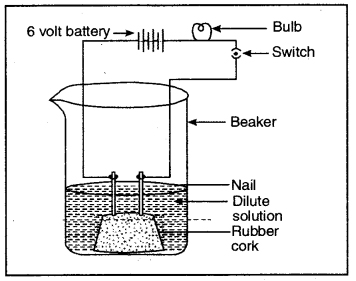
Aqueous solution of alcohol or glucose does not conduct electricity
Pour some aqueous solution of alcohol or aqueous solution of glucose in the beaker so that nails dip in it. Switch on the current. The bulb does not glow indicating that alcohol and glucose don’t dissociate in aqueous solution and hence
do not produce H+ ions although they (aq)
contain hydrogen.
Question 7. Why does not distilled water conduct electricity, whereas rainwater does?
Answer: Distilled water does not conduct electricity because it contains no ions.
Rainwater contains ions due to dissolved salts, hence it conducts electric current.
Question 8. Why do acids not show acidic behaviour in the absence of water?
Answer: This is because in the absence of water, acids do not dissociate to give hydrogen ions > H+(aq)
Question 9. Five solutions A, B, C, D and E when tested with universal indicator showed pH as 4, 1, 11, 7 and 9 respectively. Which solution is :
(a) neutral?
(b) strongly alkaline?
(c) strongly acidic?
(d) weakly acidic?
(e) weakly alkaline?
Arrange the pH in increasing order of hydrogen-ion concentration.
Solution pH Nature of Solution
A 4 Weakly acidic
B 1 Strongly acidic
C 11 Strongly alkaline
D 7 Neutral
E 9 Weakly alkaline
The increasing order of hydrogen-ion concentration is :
11 < 9 < 7 < 4 < 1 (pH values).
Question 10. Equal lengths of magnesium ribbons are taken in test tubes A and B. Hydrochloric acid (HCl) is added to test tube A, while acetic acid (CH3COOH) is added to test tube B. Amount and concentration taken for both the acids are same. In which test tube will the fizzing occur more vigorously and why?
Answer: Fizzing occurs more vigorous in test tube A as compared to in test tube B. This is because concentration of hydrogen ion, It is more in test tube A than in test tube B, as hydrochloric acid a strong acid and acetic acid (CH3COOH) is a weak acid.
Question 11. Fresh milk has a pH of 6. How do you think the pH will change as it turns into curd? Explain your answer.
Answer: Its pH will decrease due to the production of lactic acid which is acidic in nature.
Question 12. A milkman adds a very small amount of baking soda to fresh milk.
(a) Why does he shift the pH of the fresh milk from 6 to slightly alkaline?
Answer: So that the milk is not spoiled readily and medium remains basic.
(b) Why does this milk take a long time to set as curd?
Answer: Because the lactic acid produced during curding reacts with baking soda.
Question 13. Plaster of Paris should be stored in a moisture-proof container. Explain why?
Answer: This is because in presence of moisture, plaster of Paris sets to give a hard mass.

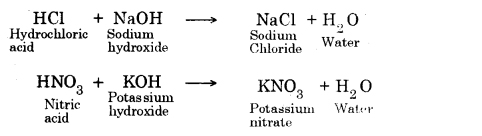
Question 14. What is a neutralisation reaction? Give two examples.
Answer: The interaction of an acid with a base to form salt and water is called neutralisation reaction.
Examples :
Question 15. Give two important uses of washing soda and baking soda.
Answer: (a) Uses of washing soda :
It is used in the manufacture of glass and soap.
It is used in the manufacture of borax.
(b) Uses of baking soda :
It is used in soda-acid fire extinguisher.
It is used for making baking powder.
PSEB 10th Class Science Extra Important Questions Chapter 2 Acids, Bases and Salts
MULTIPLE CHOICE QUESTIIN ANSWER (EXTRA)
Question 1. pH of an acidic solution is:
(A) >7
(B) <7
(C) 7
(D) 14.
Answer: (B) <7
Question 2. Neutral solution has pH:
(A) 7
(B) >7
(C) < 7
(D) 14.
Answer: (A) 7
Question 3. Common name of NaCO3. 10H2O is :
(A) Bleaching powder
(B) Baking powder
(C) Plaster of Paris
(D) Washing soda.
Answer: (D) Washing soda.
Question 4. Acid and base react to form salt and water. This reaction is called:
(A) Washing soda.
(B) Chioro-alkali
(C) Reduction
(D) None of these.
Answer: (D) None of these.
Question 5. What is used for plastering fractured bones?
(A) Cement
(B) Gypsum
(C) Plaster of Paris
(D) Soda.
Answer: (C) Plaster of Paris
Question 6. Toothpaste used for cleaning teeth is :
(A) Acidic
(B) Neutral
(C) Basic
(D) None.
Answer: (A) Acidic
Question 7. A solution turns red litmus blue, its pH is :
(A) 1
(B) 4
(C) 5
(D) 10
Answer: (D) 10.
Very Short Answer Type Questions
Question 1. What makes food sour?
Answer: Presence of acids.
Question 2. What is the reason of bitterness?
Answer: Presence of bases.
Question 3. What is the reason of acidity in stomach?
Answer: Excess of HCl acid.
Question 4. What is the effect of acid on litmus?
Answer: Blue litmus changes to red.
Question 5. What are olfactory indicators?
Answer: Some substances which change their smell in acidic or basic medium are called . olfactory indicators.
Question 6. Give three examples of olfactory indicators.
Answer: Chopped onions, clove coil, vanilla essence.
Question 7. Which gas is produced when Zinc reacts with sodium hydroxide?
Answer: Hydrogen gas.
Question 8. Which gas is produced when metal carbonates and metal hydrogen carbonates react with acid?
Answer: Carbon dioxide.
Question 9. What happens when CO2 is passed through lime water?
Answer: Lime water turns milky.
Question 10. Why milkiness of lime water disappear when excess of CO2 is passed through it?
Answer: Due to formation of Ca(HCO3)2 which is soluble in water.
Question 11. Write the name and colour of the compound formed when copper oxide reacts with dilute hydrochloric acid.
Answer: Blue-green copper chloride.
Question 12. Which name is used for metal oxide?
Answer: Alkaline oxide.
Question 13. What is the nature of non-metal oxide?
Answer: Acidic nature.
Question 14. Why does current flow in acids?
Answer: Due to ions.
Question 15. Which ion is produced in acidic solution?
Answer: Hydrogen ion (H+).
Question 16. What is used to dry, moist gas?
Answer: Calcium chloride.
Question 17. How do we represent hydrogen ion?
Answer: H+(aq) or hydronium ion (HgO+).
Question 18. Which ions is produced by bases in water?
Answer: Hydroxide (OH–) ion.
Question 19. What is base?
Answer: Alkalies which are soluble in base.
Question 20. What should we do to dilute an acid?
Answer: We should add acid to water slowly and not vice versa.
Question 21. What is dilution?
Answer: When we add acid or base in water, concentration of ions (HgO+/OH–) per unit volume decreases, this is known as dilution.
Question 22. What is name of mixture of various indicators?
Answer: Universal indicator.
Question 23. What is that which show different colour at different concen-tration of hydrogen ion in a solution?
Answer: Universal indicator.
Question 24. What is pH scale?
Answer: To know the strength of H+ ion in a solution a scale is used known as pH scale.
Question 25. What is p in pH?
Answer: ‘p’ means ‘potenz’.
Question 26. What is the range of pH scale?
Answer: 0 to 14.
Question 27. What is pH value of neutral solution?
Answer: pH value is 7.
Question 28. If pH value of solution is less than 7, then what does it indicate?
Answer: Acidic solution.
Question 29. If pH value of a solution is more than 7, then what does it indicate?
Answer: Solution is basic.
Question 30. What is the value on pH scale for lemon juice?
Answer: Nearly 2.2.
Question 31. What is the value on pH scale for pure water?
Answer: 7
Question 32. What is the value on pH scale for milk of magnesia?
Answer: 10.
Question 33. What is the value on pH scale for sodium hydroxide?
Answer: Nearly 14.
Question 34. What is pH range in which our body works?
Answer: Our body works in the pH range of 7.0 to 7.8.
Question 35. What is pH value of acid rain?
Answer: It is less than 5.6.
Question 36. In which type of river survival of aquatic animals is difficult?
Answer: When acid rain water flows to the river.
Question 37. What surrounds the venus planet?
Answer: Thick white and yellow clouds of sulphuric acid.
Question 38. Which acid is produced in our stomach?
Answer: Hydrochloric acid.
Question 39. What is produced in the stomach when there is indigestion.
Answer: Excess of HCl.
Question 40. What is used for treating excess of acid in the stomach?
Answer: Antacids (mild bases).
Question 41. When does tooth decay begin?
Answer: When pH value in less than 5.5.
Question 42. Teeth are made up of which substance?
Answer: Calcium phosphate.
Question 43. Why do we feel pain due to bee sting?
Answer: Due to acid.
Question 44. Which substance is applied on the stinging area which gives relief from pain?
Answer: Weak base like baking soda.
Question 45. What do the stinging hair of nettle plant secret?
Answer: Methanoic acid.
Question 46. What is the remedy for sting of herbaceous plant Nettle?
Answer: Rub leaves of dock plant.
Question 47. Which acid is there in vinegar?
Answer: Acetic acid.
Question 48. Which acid is there in lemon, orange?
Answer: Citric acid.
Question 49. Which acid is in curd and milk?
Answer: Lactic acid.
Question 50. What is main source of salt?
Answer: Sea water.